
SINTESIS DAN KARAKTERISASI MIKRO PARTIKEL KARBON AKTIF TANDAN KOSONG KELAPA SAWIT
DOI:
https://doi.org/10.23960/aec.v7i02.2022.p177-188Abstract
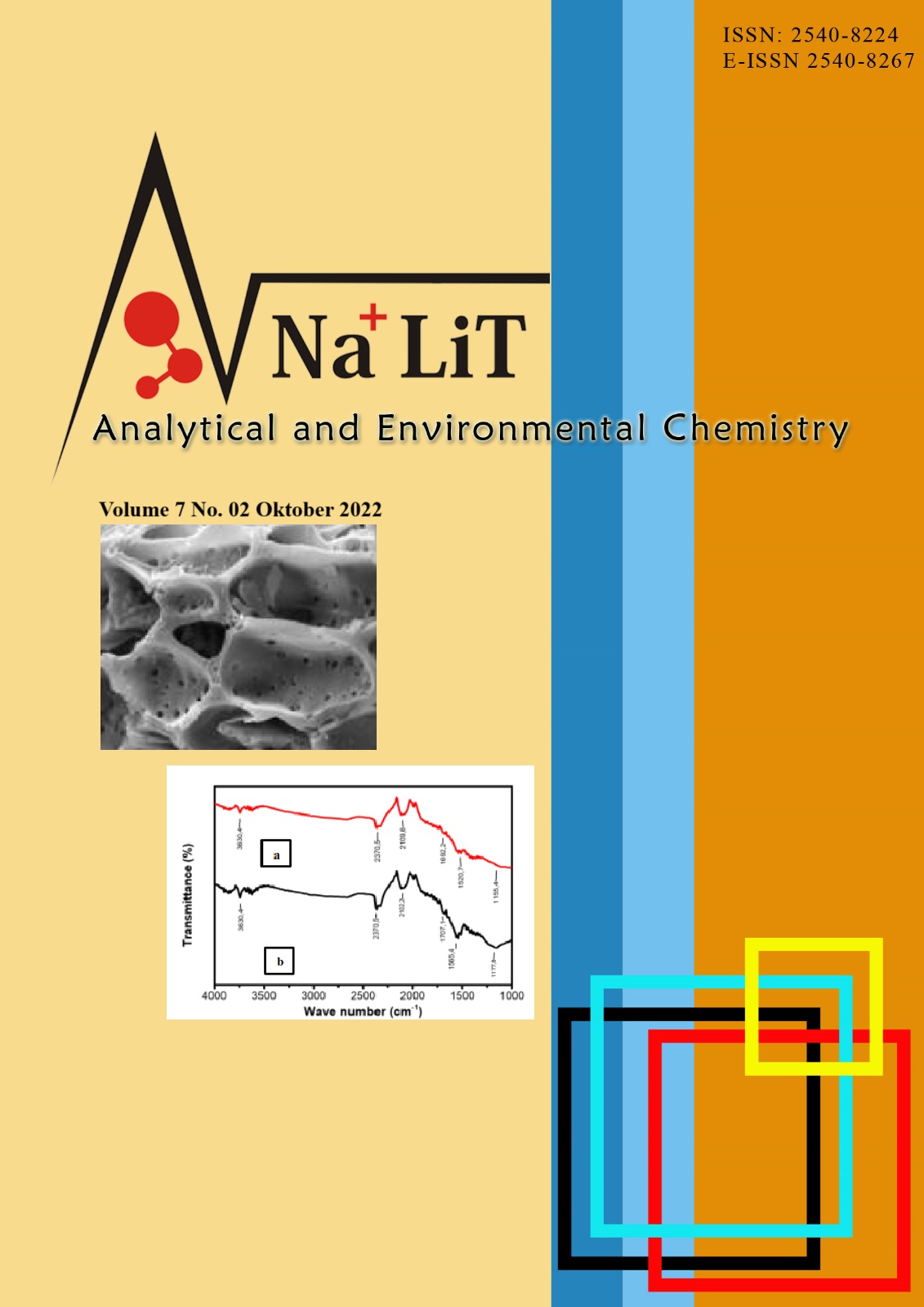
Karbon aktif memiliki banyak kegunaan dalam berbagai bidang di antaranya lingkungan, kesehatan dan farmasi, serta kecantikan. Fungsi dan kegunaan karbon aktif terkait erat dengan ukuran partikel karbon aktif itu sendiri. Telah dilakukan sintesis dan karakterisasi karbon aktif tandan kosong kelapa sawit (TKKS) dalam ukuran mikropartikel. Sintesis mikropartikel karbon aktif dilakukan secara top down dengan menggunakan planetary ball milling. Karakterisasi terhadap mikropartikel karbon TKKS meliputi uji mutu berdasarkan SNI No. 06-3730-1995 tentang arang aktif teknis yaitu parameter kadar air, kadar abu, uji spektrum Fourier Transform Infrared (FTIR), dan uji Scaning Electron Microscopy (SEM). Mikropartikel karbon aktif TKKS telah berhasil disintesis selama 10 jam mencapai ukuran partikel 1,60 µm, dan telah memenuhi standar kualitas SNI No. 06-3730-1995 pada parameter kadar air sebsar 3,03%, daya serap terhadap iodin dan daya serap terhadap biru metilen berturut-turut sebesar 1547,58% dan 148,21 mg/g.
Kata kunci: FTIR, karbon aktif, mikropartikel, SEM, TKKS.
Downloads
Published
How to Cite
Issue
Section
License
Copyright (c) 2024 Analit: Analytical and Environmental Chemistry

This work is licensed under a Creative Commons Attribution-ShareAlike 4.0 International License.
- Authors retain copyright and acknowledge that the Analit : Analytical and Environmental Chemistry is the first publisher, licensed under a Creative Commons Attribution 4.0 International License.
- Authors are able to enter into separate, additional contractual arrangements for the non-exclusive distribution of the journal's published version of the work (e.g., post it to an institutional repository or publish it in a book), with an acknowledgment of its initial publication in this journal.
- Authors are permitted and encouraged to post their work online (e.g., in institutional repositories or on their website) prior to and during the submission process, as it can lead to productive exchanges and earlier and greater citation of published work.


