
THE BOD-COD REDUCTION IN LEACHATE WATER USING RICE HUSK ASH
DOI:
https://doi.org/10.23960/aec.v7i02.2022.p189-196Abstract
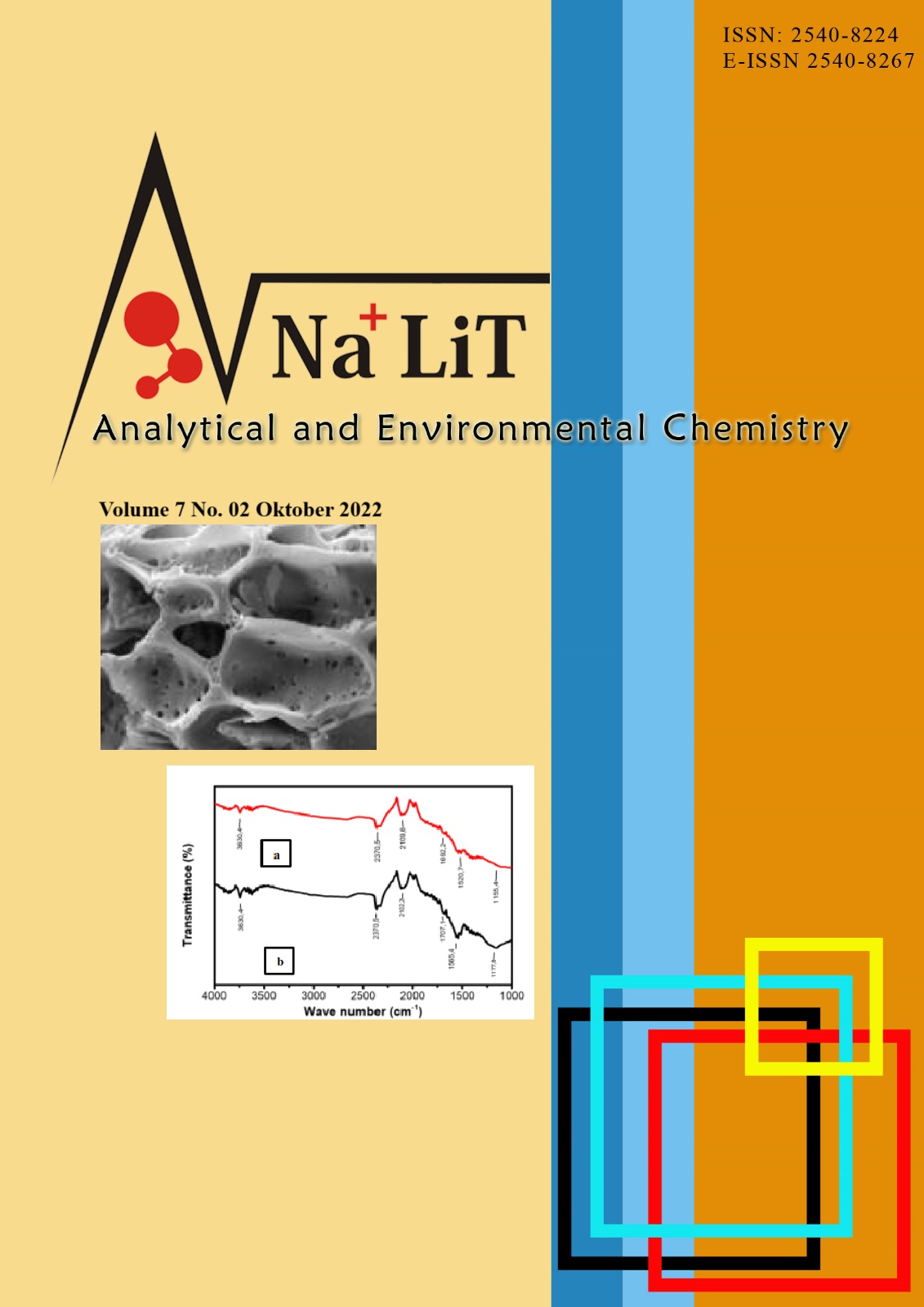
The purpose of this research is investigating the effect of rice husk ash in reducing of BOD, COD and TSS in leachate water. In this research, the protype of water purifier was created and the rice husk was conducted in this instrument. Before using as an adsorbent, the rice husk ash was heated at furnace at 500 °C. The process of water purifying using rice husk as an adsorbent was performed from 0 min to 120 min. The BOD-COD levels and the TSS content in leachate water was investigated before and after purifying using rice husk ash. The BOD level at this time was decreased from 412.5 to 126.25mg/L during contact time optimum 45 min.. The optimum time in reducing COD was also reduced from 861.0 to 261.25 mg/L during 45 min respectively. After 45 min , the content of BOD and COD was increased. The TSS content of leachate water after treatment using rice husk ash was changed from 99.0 to 5.0 mg/L after 30 min contact with rice husk. We conclude that the rice husk was effective in decreasing BOD, COD and TSS in leachate water.
Keywords: Rice husk ash, BOD, COD.
Downloads
Published
How to Cite
Issue
Section
License
Copyright (c) 2024 Analit: Analytical and Environmental Chemistry

This work is licensed under a Creative Commons Attribution-ShareAlike 4.0 International License.
- Authors retain copyright and acknowledge that the Analit : Analytical and Environmental Chemistry is the first publisher, licensed under a Creative Commons Attribution 4.0 International License.
- Authors are able to enter into separate, additional contractual arrangements for the non-exclusive distribution of the journal's published version of the work (e.g., post it to an institutional repository or publish it in a book), with an acknowledgment of its initial publication in this journal.
- Authors are permitted and encouraged to post their work online (e.g., in institutional repositories or on their website) prior to and during the submission process, as it can lead to productive exchanges and earlier and greater citation of published work.


