
PENGARUH PENAMBAHAN PLASTICIZER TERHADAP KARAKTERISTIK BIOPLASTIK DARI SELULOSA LIMBAH KERTAS
DOI:
https://doi.org/10.23960/aec.v7i02.2022.p197-208Abstract
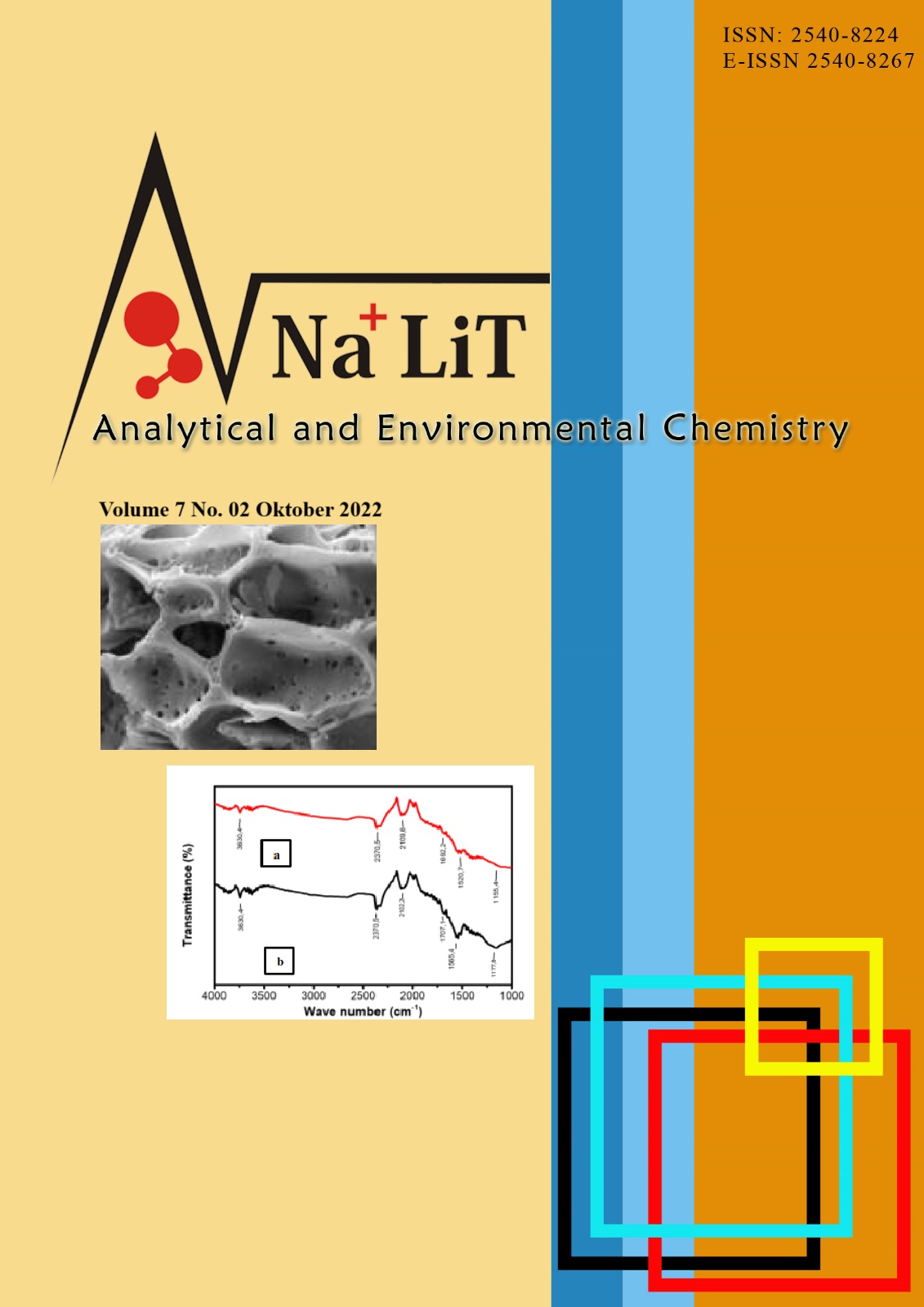
Kertas HVS umumnya dijumpai terutama mahasiswa dalam menunjang aktivitas perkuliahannya, sehingga limbah kertas mudah ditemukan. Oleh karena itu untuk mengatasi permasalahan limbah kertas perlu daur ulang kertas menjadi bioplastik. Penelitian bertujuan untuk mengetahui karakteristik bioplastik limbah kertas HVS dan pengaruh penambahan Plasticizer. Tahap penelitian meliputi ekstraksi selulosa kertas HVS, sintesis selulosa asetat, sintesis bioplastik dan karakterisasi. Hasil identifikasi gugus fungsi terdapat gugus C=O, dan C-O ciri khas selulosa asetat. Uji ketahanan air terbaik terdapat pada kontrol 0% dengan ketahanan air sebesar 75,81%. Sifat biodegradasi terbaik pada penambahan plasticizer konsentrasi 25% (gliserol maupun sorbitol) dengan nilai kehilangan massa masing-masing 28,33% dan 37,58%. Penambahan plasticizer menunjukkan sifat mekanik bioplastik cenderung menurun. Disimpulkan bahwa bioplastik limbah kertas HVS yang terbaik terdapat pada kontrol 0% nilai kuat tarik sebesar 3,2893 N/mm2, elongasi sebesar 5,16%, nilai modulus young 0,6002 N.
Kata kunci: Bioplastik, plasticizer, selulosa asetat.
Downloads
Published
How to Cite
Issue
Section
License
Copyright (c) 2024 Analit: Analytical and Environmental Chemistry

This work is licensed under a Creative Commons Attribution-ShareAlike 4.0 International License.
- Authors retain copyright and acknowledge that the Analit : Analytical and Environmental Chemistry is the first publisher, licensed under a Creative Commons Attribution 4.0 International License.
- Authors are able to enter into separate, additional contractual arrangements for the non-exclusive distribution of the journal's published version of the work (e.g., post it to an institutional repository or publish it in a book), with an acknowledgment of its initial publication in this journal.
- Authors are permitted and encouraged to post their work online (e.g., in institutional repositories or on their website) prior to and during the submission process, as it can lead to productive exchanges and earlier and greater citation of published work.


